
Set up GemiGuard VPN on GL.iNet Mango (GL-MT300N-V2)
Download a configuration file, a small file with your connection settings, from your account and upload it in the router’s admin panel. Every phone, laptop and TV connected to the Mango then goes through GemiGuard VPN.
Tested on firmware 4.3.30 on 7 November 2026.
Before you start
- A GL.iNet Mango (GL-MT300N-V2) on firmware 4.3, with internet access.
- A GemiGuard VPN account with time on it. The router uses one of your five device slots.
- A computer or phone connected to the Mango, with the admin panel open (usually at 192.168.8.1).
Steps
Download a configuration file for the router
In your account, open Devices and choose Add device. Give it a name such as
Mango, keep Create the key in this browser (download a configuration file) and add it.Download the configuration file of the server you want. The file is named after the server, for example
frankfurt1.conf.Open WireGuard Client
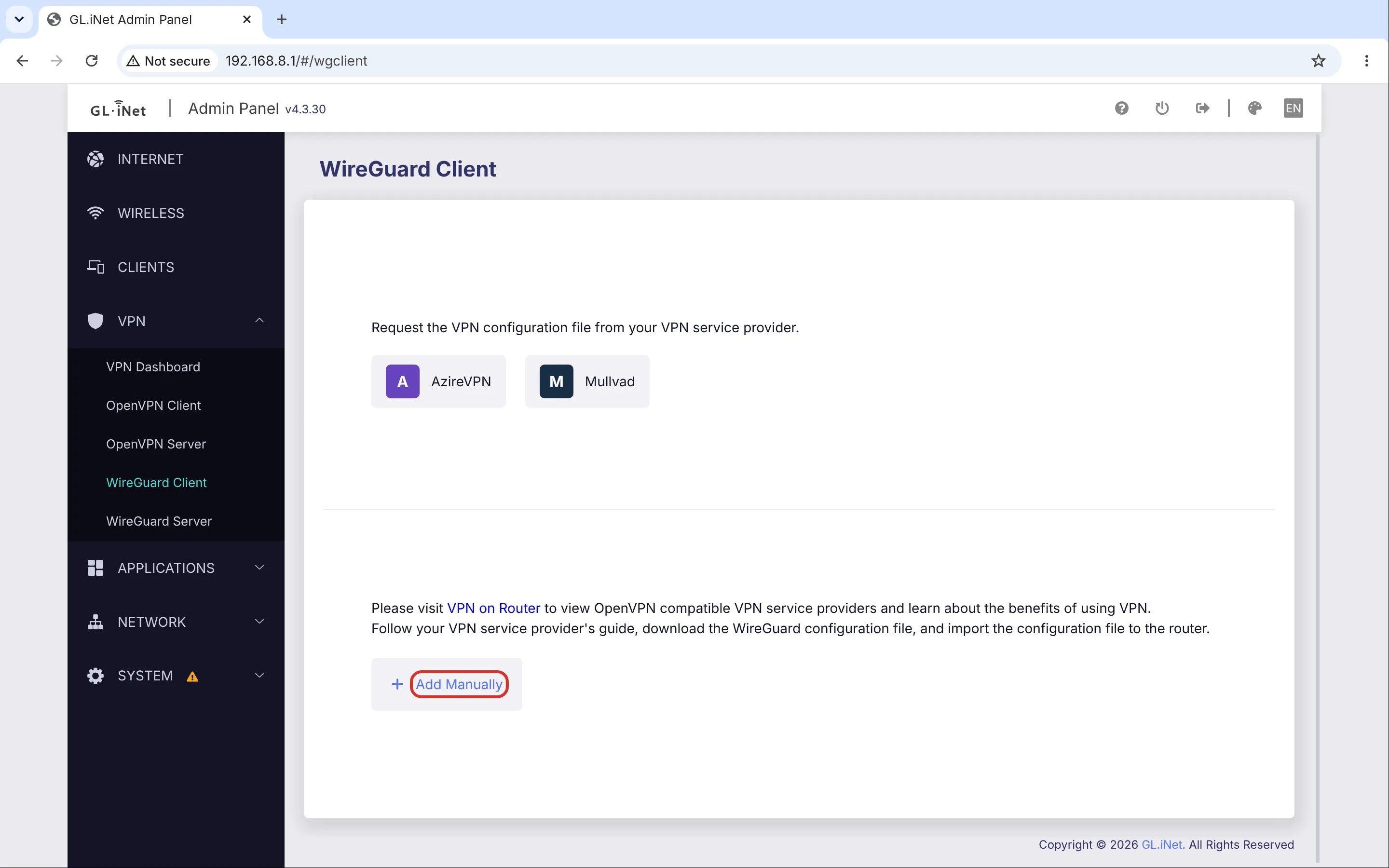
Open VPN, then WireGuard Client, and click Add Manually.
Name the group
A field named New Provider appears under the provider list. Replace the name with
GemiGuard VPNand click the check mark.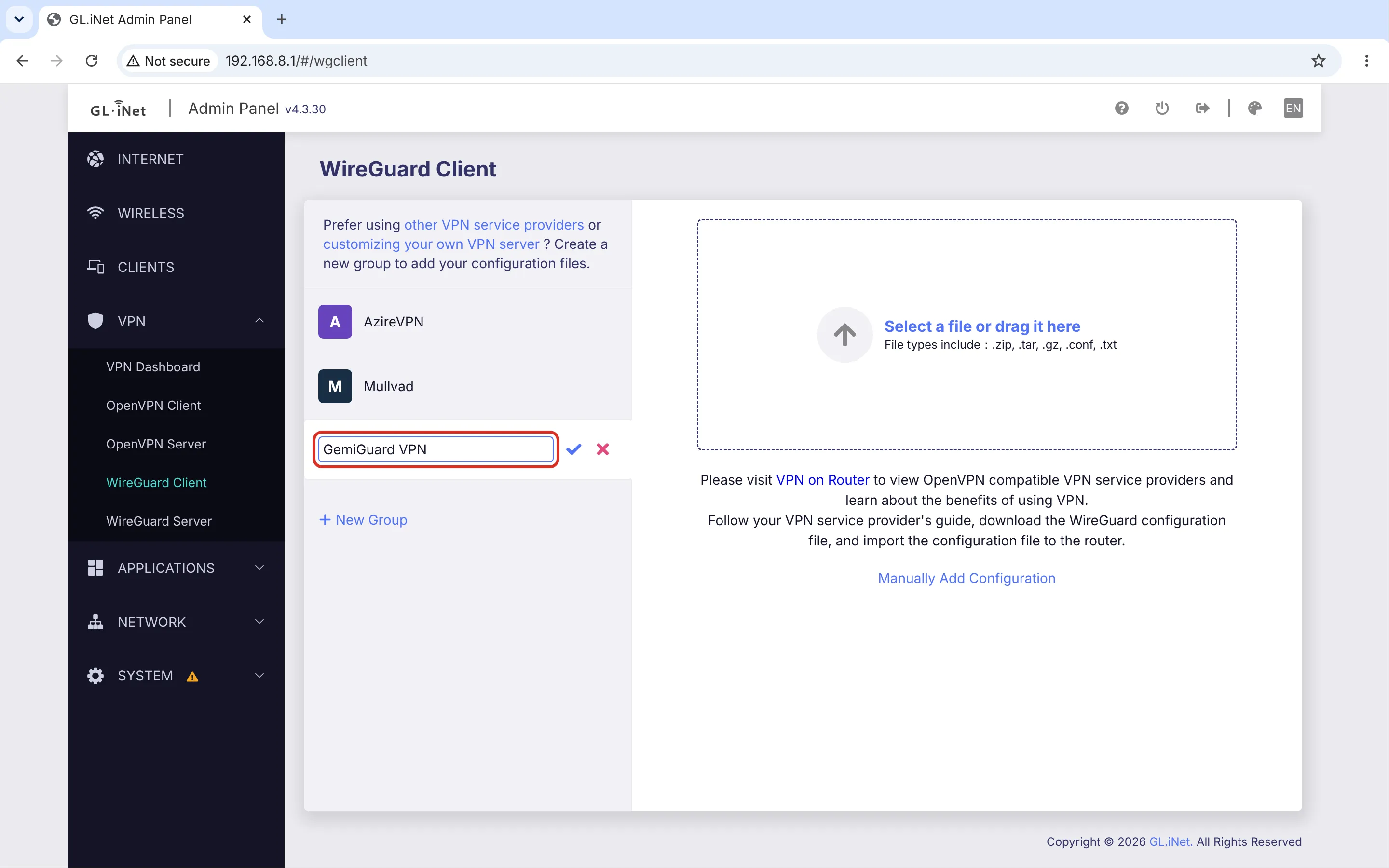
Upload the configuration file
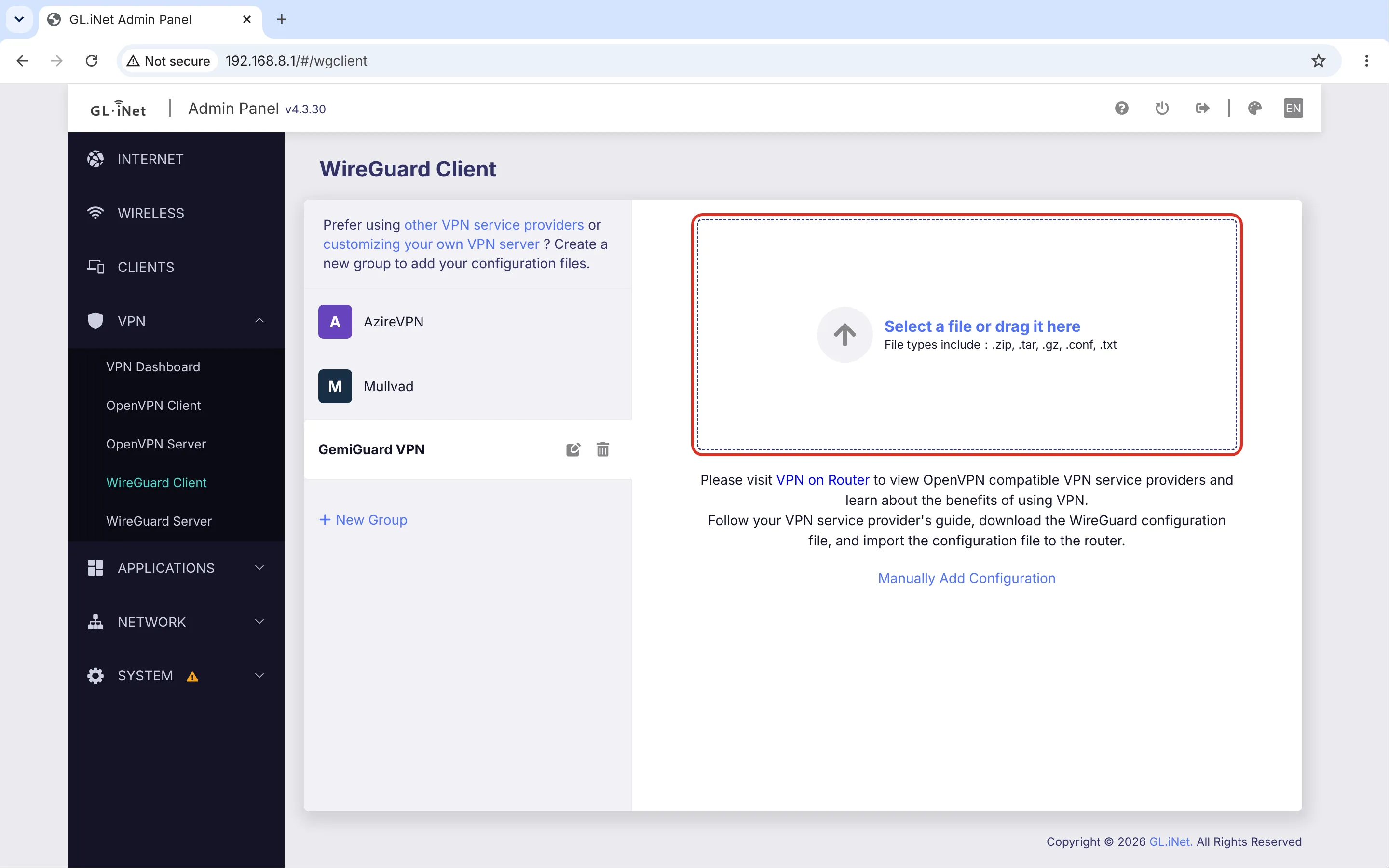
With the group selected, click Select a file to upload or drag it here and choose your
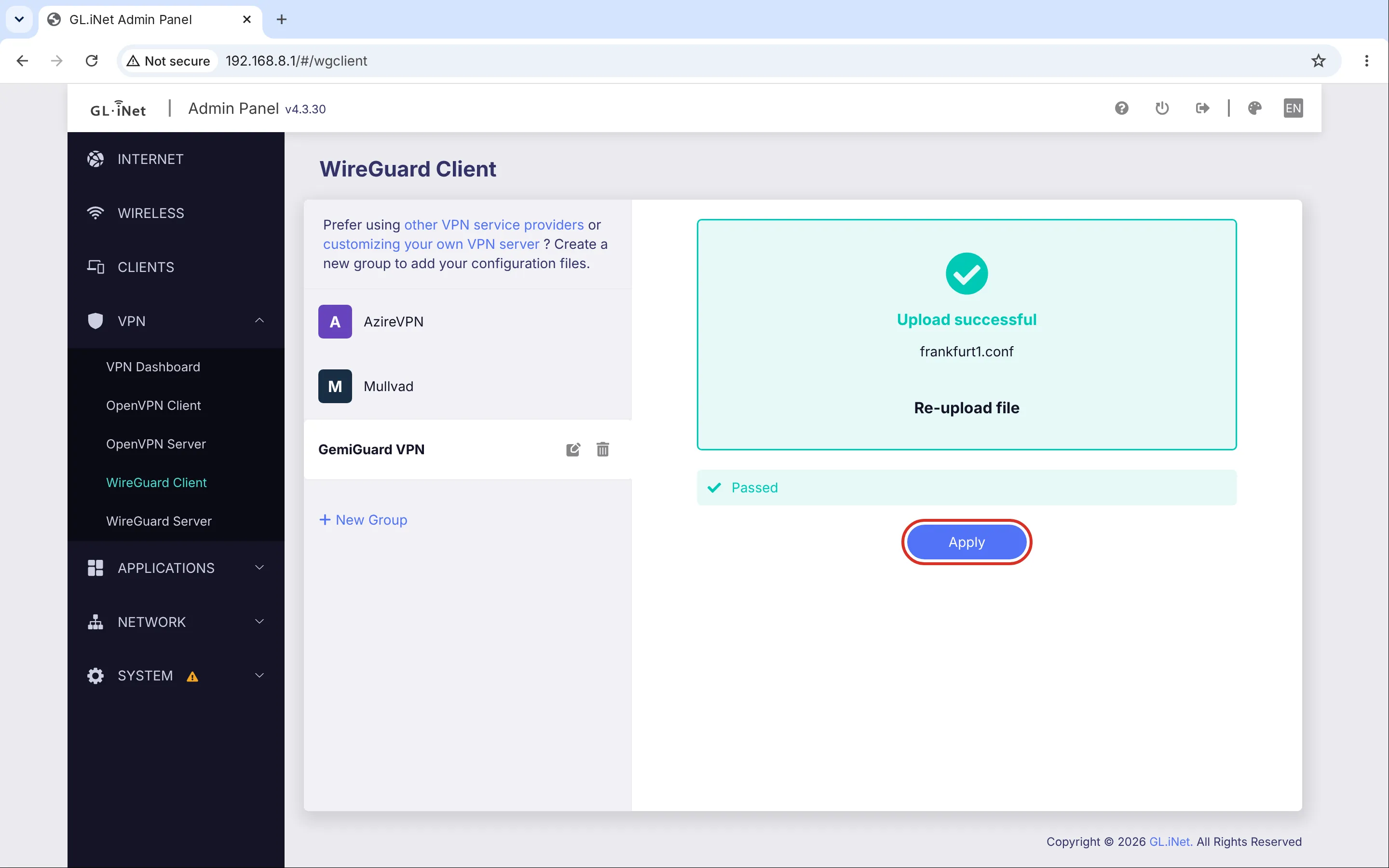
.conffile.When the panel shows Upload successful and GL.iNet’s check Passed, click Apply.
Check the configuration file
The configuration file appears in the group as
frankfurt1.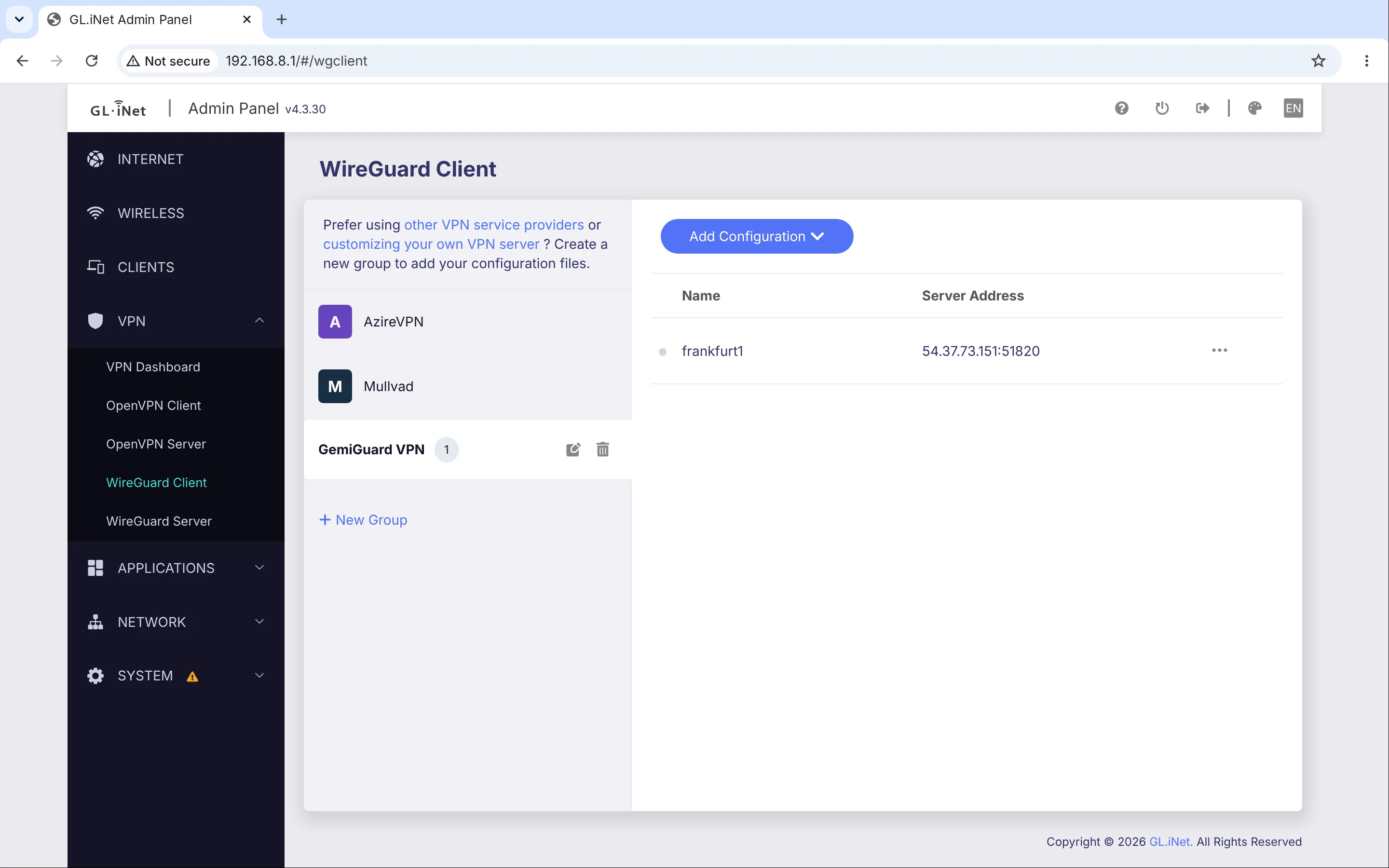
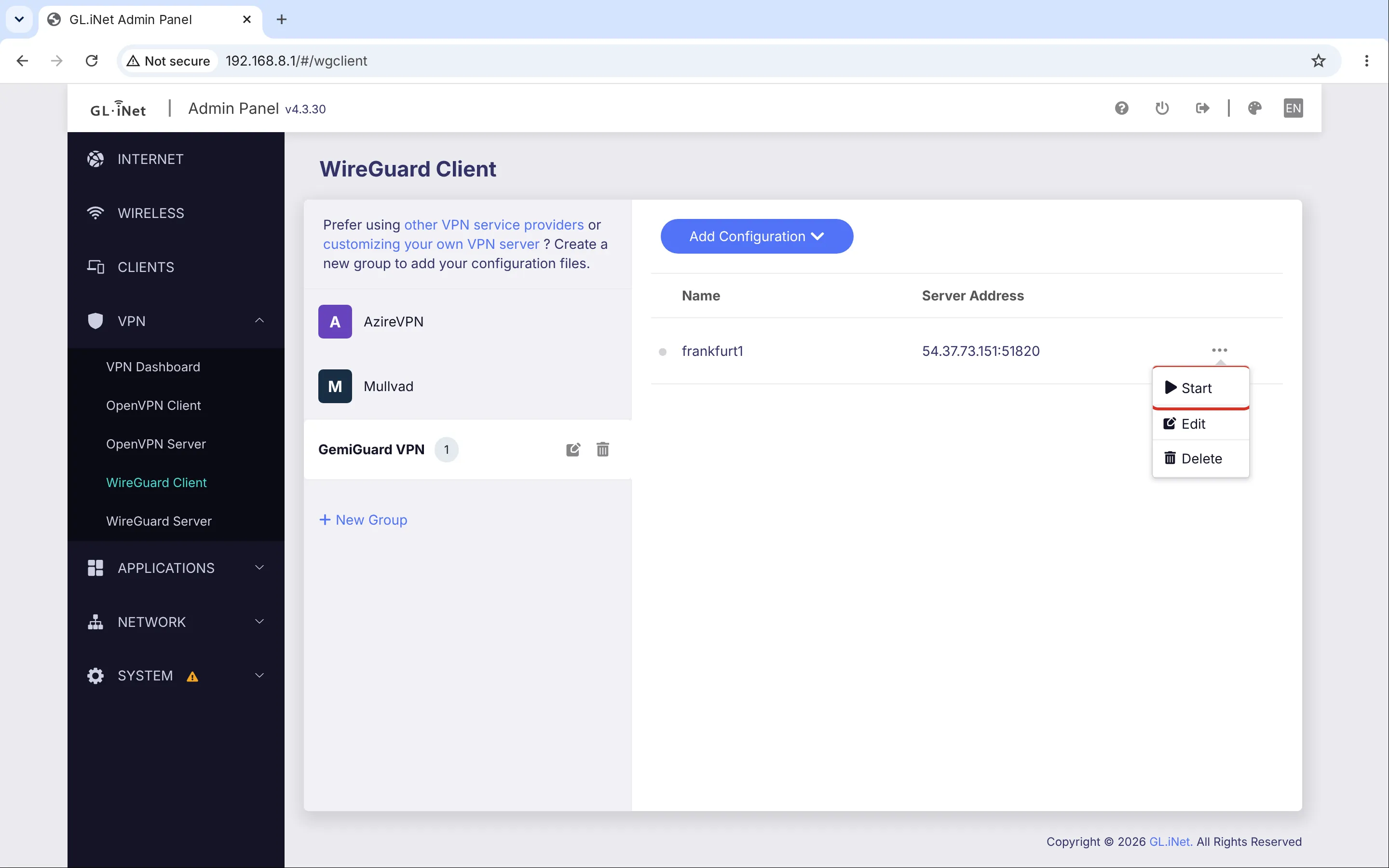
Start the tunnel
Click ... at the end of the row and choose Start.
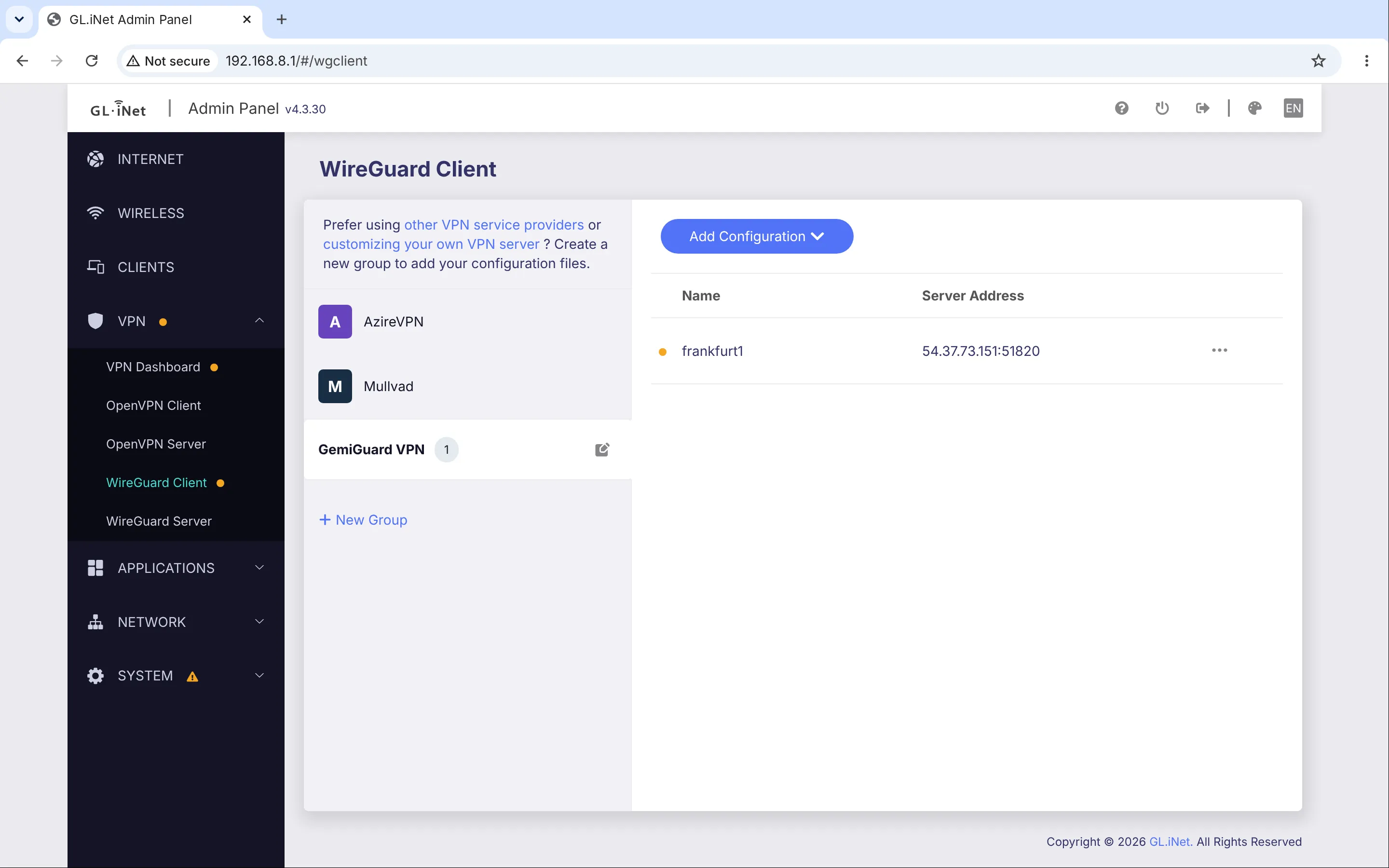
A dot next to the name marks the configuration file in use.
Turn on Block Non-VPN Traffic
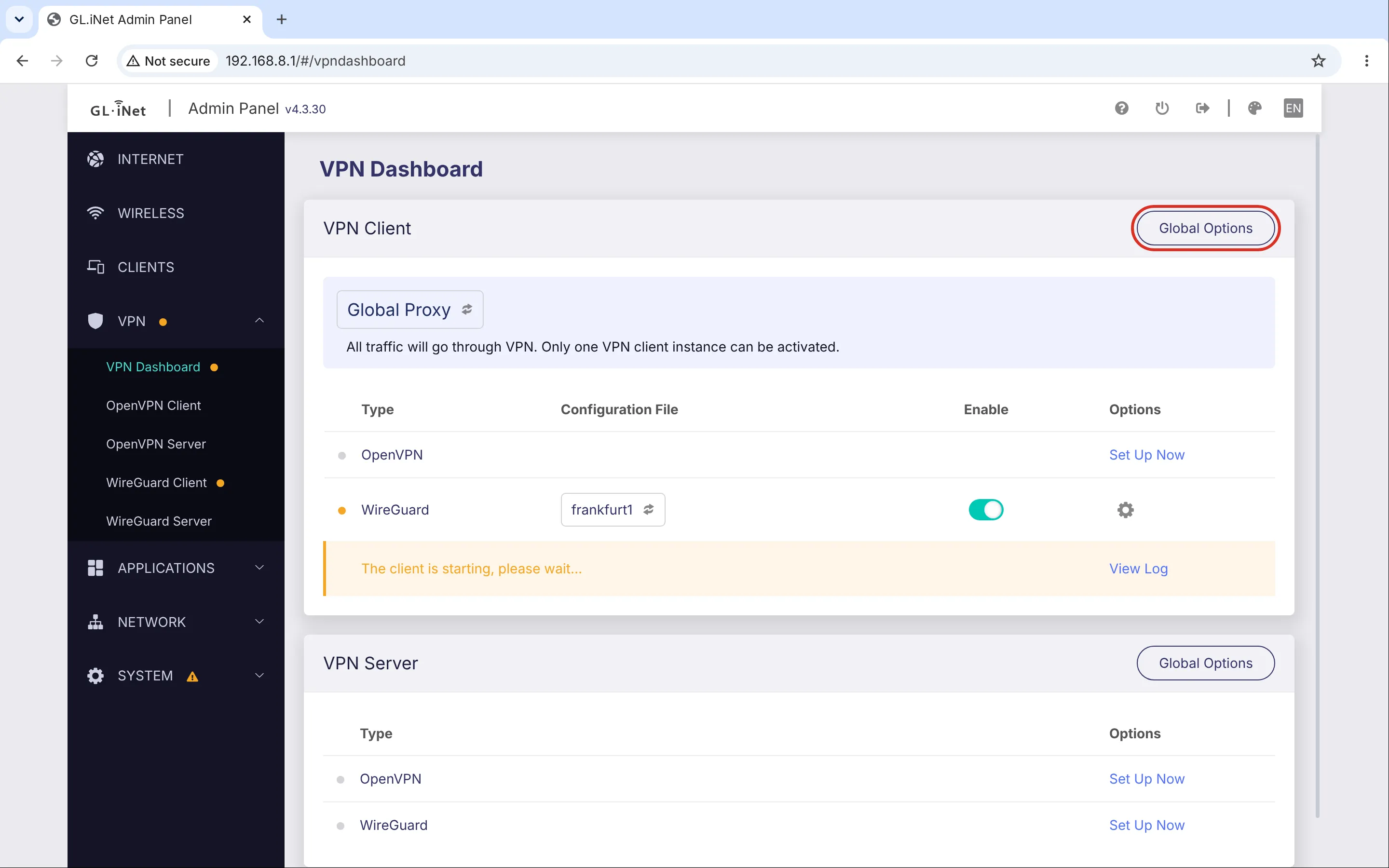
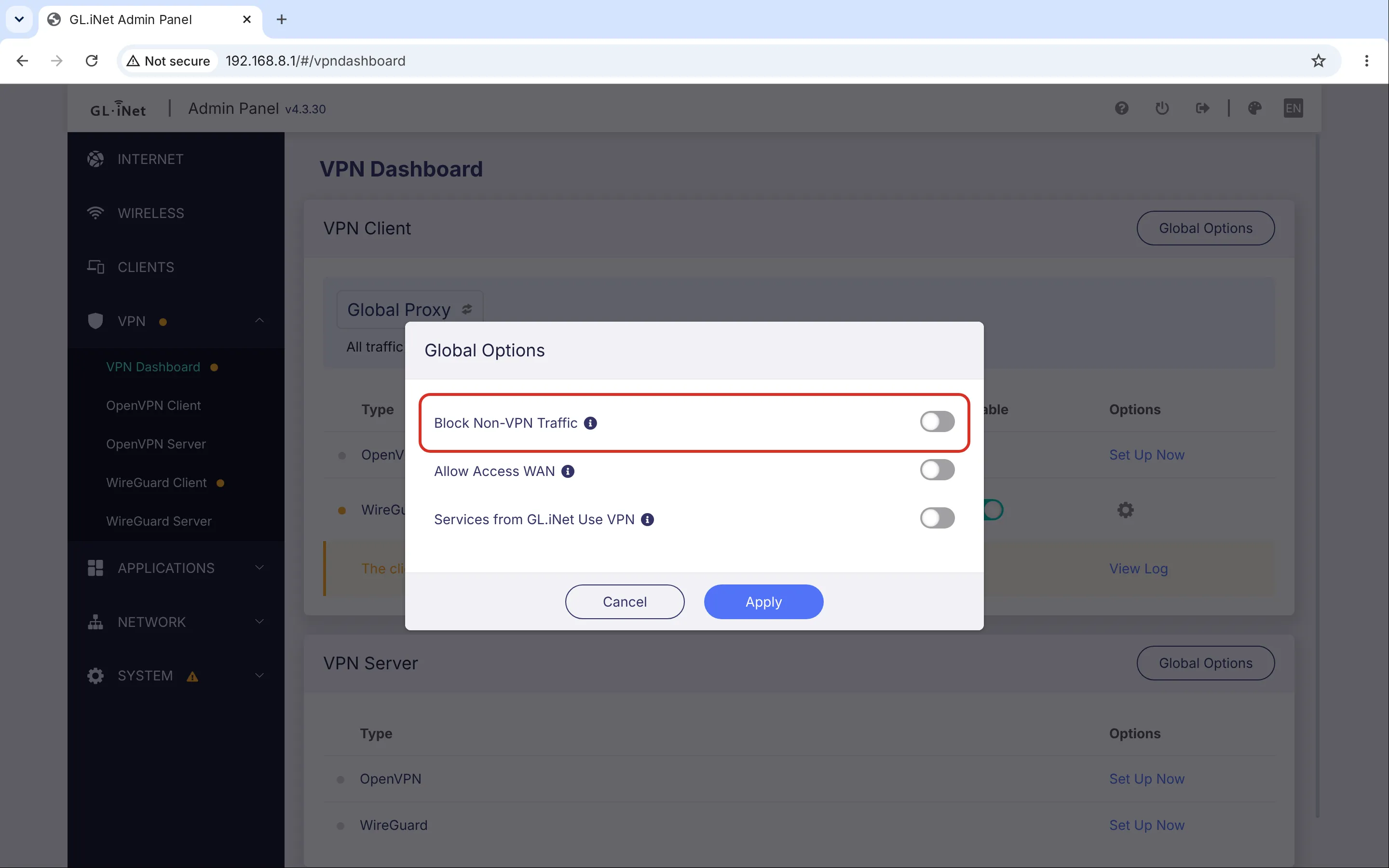
Open VPN Dashboard and click Global Options.
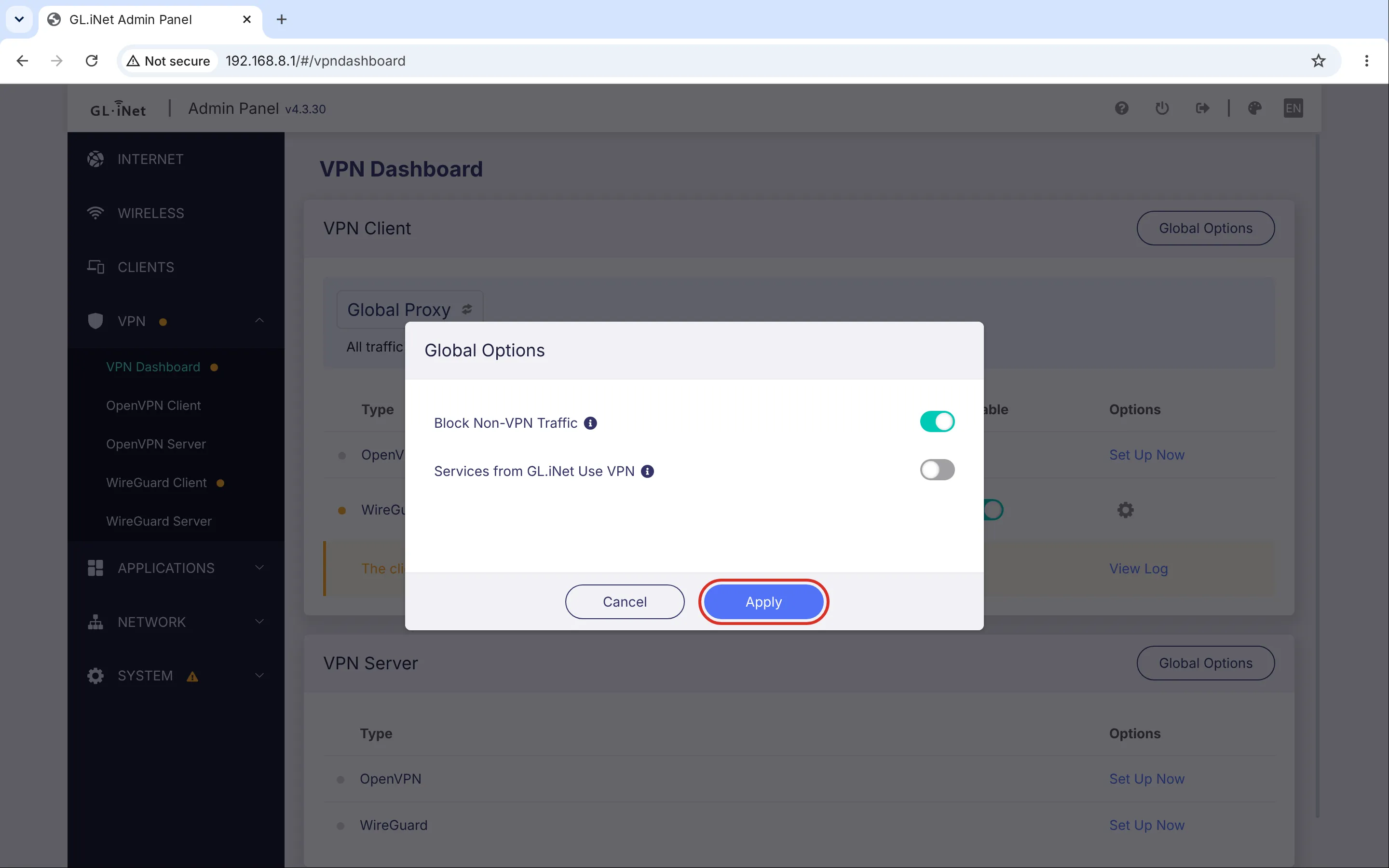
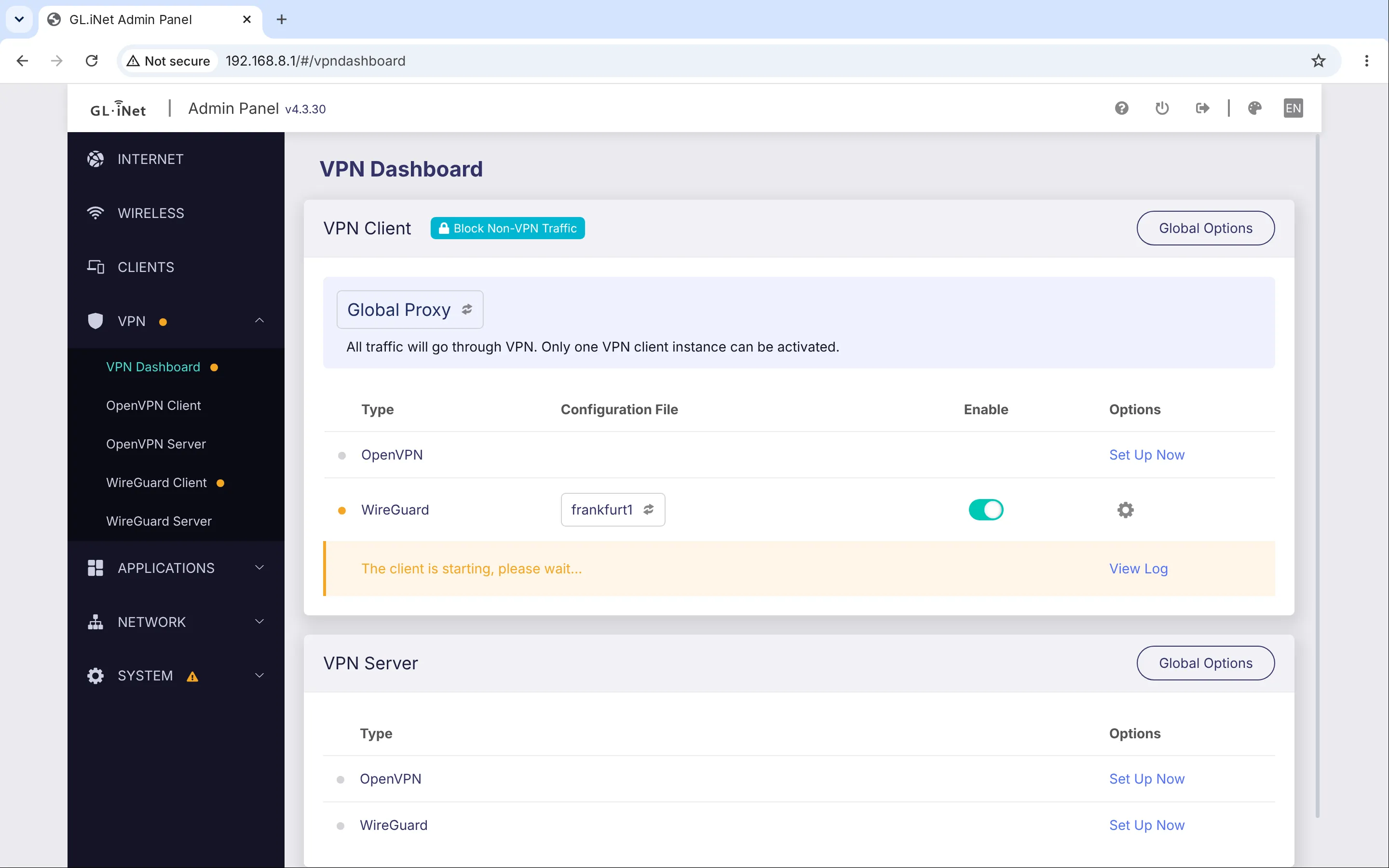
Turn on Block Non-VPN Traffic and click Apply. The dashboard then shows a Block Non-VPN Traffic badge.
Check that it works
- In your account, open Devices: Last connected for the router shows a time from the last minute or two.
- On a device connected to the Mango, open ip.gemiguard.com: it shows your public IP address, which should be the address of the server you chose.
Troubleshooting
- Last connected stays empty
- Our servers answer on the UDP port shown in your configuration file, which some networks block. Try the configuration file of another server, and check that the router itself has internet.
- Devices have no internet while the tunnel connects
- Block Non-VPN Traffic holds traffic until the tunnel connects. Check Last connected in your account, or try another server.
- I want another server
- Choose New key on the device in your account, download that server’s configuration file, upload it to the same group (step 4) and choose Start in its row menu.
Switch it off
In VPN Dashboard, turn off the Enable switch in the WireGuard row, and turn off Block Non-VPN Traffic under Global Options.
Get a configuration file for your router
One device slot covers every device behind the router. 6 months cost 29 USDT, 12 months 49 USDT, 24 months 79 USDT.
Guides for other routers
- OpenWrt
- MikroTik RouterOS 7
- Teltonika RutOS
- GL.iNet Mudi 7 (GL-E5800)
- GL.iNet Opal (GL-SFT1200)
- GL.iNet Flint 4 (GL-BE14000)
- GL.iNet Slate 7 Pro (GL-BE10000)
- GL.iNet Flint (GL-AX1800)
- GL.iNet Mango 2 (GL-MG1300)
- GL.iNet Mudi v2 (GL-E750V2)
- GL.iNet Puli (GL-XE300)
- GL.iNet Shadow (GL-AR300M16)
- GL.iNet Flint 3e (GL-BE6500)
- GL.iNet Flint 3 (GL-BE9300)
- GL.iNet Beryl 7 (GL-MT3600BE)
- GL.iNet Flint 2 (GL-MT6000)
- GL.iNet Slate 7 (GL-BE3600)
- GL.iNet Beryl AX (GL-MT3000)
- GL.iNet Spitz AX (GL-X3000)
- GL.iNet Puli AX (GL-XE3000)
- GL.iNet Spitz Plus (GL-X2000)
- All router guides